
By Konika Gayen| 5 minutes read
Published: May 2026

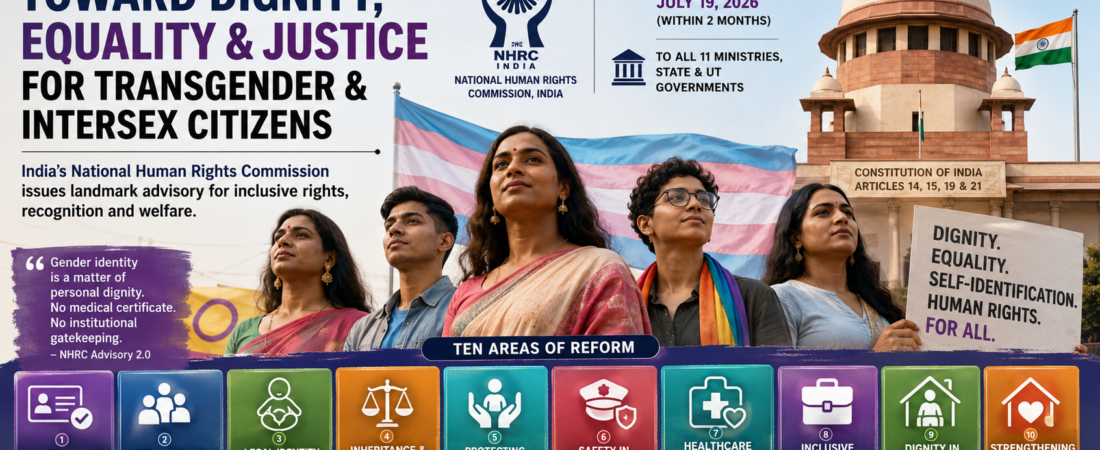
On May 19, 2026, India’s National Human Rights Commission (NHRC) issued a sweeping set of recommendations — officially called Advisory 2.0 — urging the Union Government, eleven central ministries, and all state and union territory governments to significantly strengthen protections for transgender and intersex persons across the country.
The advisory covers ten broad areas of reform, from how gender is recorded in the national Census to how elderly transgender persons access welfare schemes. It also sets a firm two-month deadline for all concerned authorities to file an Action Taken Report (ATR) detailing steps taken toward implementation.
Why Now?
The NHRC’s first advisory on transgender welfare was issued in September 2023. Since then, the Commission conducted field visits and institutional reviews to assess how well the law was actually working for the community.
The picture that emerged was stark. Transgender persons in India have a literacy rate of just 56% and a formal employment rate of only 6%. Discrimination in hospitals, schools, workplaces, and legal institutions remains widespread. Trans-men and non-binary individuals are often excluded entirely from existing welfare frameworks.
The situation was made more urgent by recent amendments to the Transgender Persons (Protection of Rights) Act, which the NHRC says have rolled back a key constitutional protection — the right to self-identify one’s gender.
The Self-Identification Controversy
At the heart of Advisory 2.0 is a direct challenge to parliamentary amendments passed earlier in 2026.
Those amendments removed clauses that had allowed transgender individuals to self-identify their gender for legal purposes — for identity certificates, school admissions, and official documentation. In their place, Parliament introduced a mandatory medical screening process administered by the Ministry of Social Justice and Empowerment.
The NHRC has pushed back firmly. The Commission states that requiring medical proof to confirm one’s gender identity causes “immense distress” and has triggered widespread protests within the community. It recommends a return to self-identification as the basis for legal recognition — no medical certificate, no institutional gatekeeping.
This is not a fringe position. International human rights frameworks, including the Yogyakarta Principles, have long held that gender identity is a matter of personal dignity and cannot be contingent on medical procedures.
Counting Every Identity: Census Reform
One of the most consequential recommendations in Advisory 2.0 concerns how gender is recorded in national data.
For years, India’s Census and national surveys have grouped all transgender individuals under a single label — “Other” or “Third Gender.” The NHRC has now urged the Office of the Registrar General and Census Commissioner to disaggregate this into distinct categories: Transmen, Transwomen, and Intersex.
Accurate data is the foundation of effective policy. Without it, governments cannot design targeted welfare programmes, measure outcomes, or allocate resources fairly. This seemingly technical change has very practical consequences for millions of lives.
Ten Areas of Reform
Beyond self-identification and Census reform, Advisory 2.0 covers eight additional areas:
- Legal Identity from Birth: The Advisory calls for amending the Registration of Births and Deaths Act to include gender-inclusive options on birth certificates — such as Intersex, Indeterminate, or Prefer not to state at birth — so that children born with diverse sex characteristics are not incorrectly categorised from the start.
Inheritance and Property Rights. Succession laws, including the Hindu Succession Act, do not explicitly recognise transgender individuals as legal heirs. The Advisory recommends amending these laws to clearly include transgender and intersex persons under definitions of “son,” “daughter,” and “heir,” ensuring equal inheritance rights. - Protecting Children: The Advisory asks for changes to the Juvenile Justice Act to better accommodate gender non-conforming children, and recommends that every state establish at least one pilot childcare facility designed specifically to support transgender and gender-diverse youth.
- Safety in Custody: Transgender persons in police custody and correctional facilities face particular risks — including privacy violations, abuse, and denial of healthcare. The Advisory directs authorities to develop comprehensive Standard Operating Procedures covering how searches are conducted, how inmates are housed, and how gender-affirming healthcare is provided in custodial settings.
- Healthcare with Dignity: The Commission calls for standardised protocols for gender-affirming care, regulation of the costs of Sex Reassignment Surgery, and equal insurance coverage for transgender healthcare needs. It also explicitly prohibits coercive or non-consensual medical procedures on intersex children except in genuine, life-threatening emergencies.
- Inclusive Workplaces: Employers — public and private — are urged to adopt gender-neutral facilities, inclusive HR policies, and formal grievance mechanisms. Mandatory diversity disclosures are also recommended.
- Dignity in Old Age: For elderly transgender persons, the Advisory recommends simplifying access to government welfare schemes through self-identification-based enrolment, and establishing transgender-inclusive old-age homes and community shelters that provide privacy, healthcare, and emotional support.
- Strengthening Garima Greh Shelters: The Advisory calls for expanding and improving Garima Greh — government-run shelter homes for transgender persons — ensuring they are adequately resourced and accessible across the country.
What Happens Next?
The NHRC has not merely issued recommendations. It has issued a deadline.
All eleven ministries, state governments, and union territories have been asked to submit an Action Taken Report within two months, detailing specific steps taken toward implementation.
Whether those reports lead to real change depends on political will, sustained advocacy, and public awareness. Advisory 2.0 does not have the force of law — it is a recommendation. But it carries significant moral and institutional authority, and non-compliance is visible.
The Bigger Picture
Advisory 2.0 arrives at a moment of contradiction. India has, in recent years, taken steps forward on transgender rights — the 2019 Act, Garima Greh shelters, welfare schemes — but also steps backward, as the 2026 amendments demonstrate.
The NHRC is, in effect, trying to hold the government accountable to the Constitution’s own guarantees of dignity, equality, and freedom. Articles 14, 15, 19, and 21 of the Indian Constitution have been interpreted by the Supreme Court — most notably in the landmark NALSA v. Union of India (2014) judgment — to protect the rights of transgender persons, including the right to self-identify.
The advisory is a reminder that rights on paper must translate into rights in practice. That a literacy rate of 56% and an employment rate of 6% are not acceptable outcomes for any community in a democratic republic. And that the measure of a nation’s commitment to human rights is how it treats its most marginalised citizens.
This article is based on NHRC Advisory 2.0, issued May 19, 2026, and verified news reports from Greater Kashmir, Telangana Today, The Policy Edge, and Vision IAS.