
By Konika Gayen Keshervani | June 2026 | 5 Minutes Read
Summary : The Right to Privacy in India, though absent from the Constitution explicitly, was declared a fundamental right under Article 21 by the Supreme Court in the landmark 2017 Puttaswamy judgment.
Privacy is one of those rights that most people feel instinctively, yet struggle to define precisely. It is the right to be left alone — to control what you share, with whom, and when. In India, this right had a complicated journey before it finally received full constitutional recognition.
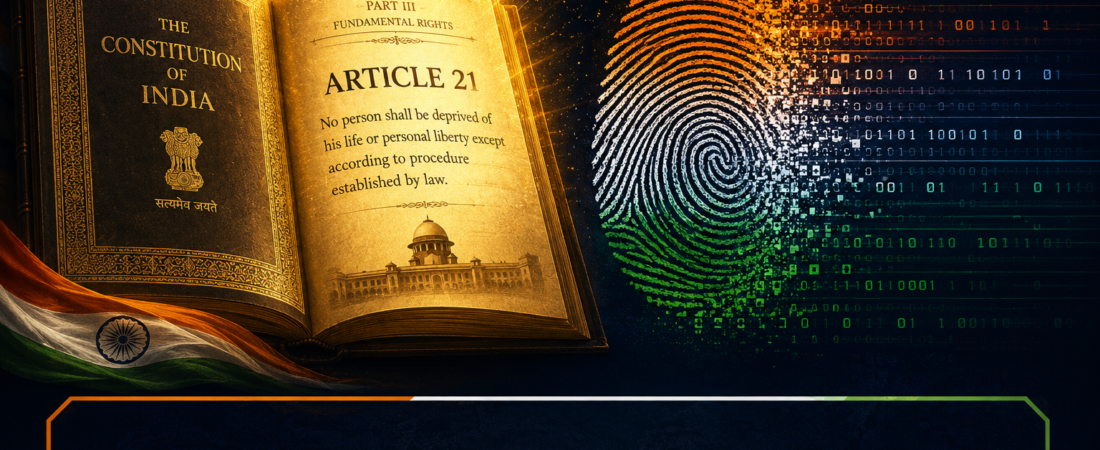
Unlike countries that explicitly enshrine privacy in their constitutions, India’s founding document — the Constitution of 1950 — makes no direct mention of the right to privacy. Yet, through decades of judicial interpretation, this right has been read into the fabric of Article 21, which guarantees every person the right to life and personal liberty.
In 2017, the Supreme Court of India put the debate to rest once and for all. In the landmark judgment of Justice K.S. Puttaswamy (Retd.) v. Union of India, a nine-judge Constitution Bench unanimously declared that the Right to Privacy is a fundamental right of every Indian citizen. What followed was a transformation in how India understands, protects, and regulates privacy — both offline and in the digital world.
The Constitutional Foundation
India’s Constitution does not list privacy as a standalone fundamental right. However, Part III of the Constitution — which deals with fundamental rights — contains several provisions from which privacy can be derived:
- Article 21: Right to Life and Personal Liberty — the primary home of the right to privacy.
- Article 19(1)(a): Freedom of speech and expression — which includes the right not to be compelled to speak.
- Article 14: Right to Equality — which prevents arbitrary state action, including arbitrary surveillance.
- Article 20(3): Protection against self-incrimination — an early judicial anchor for informational privacy
The phrase ‘personal liberty’ in Article 21 has been interpreted by the Supreme Court with the widest possible amplitude over the years. In Francis Coralie v. Union Territory of Delhi (1981), Justice P.N. Bhagwati described Article 21 as embodying ‘a constitutional value of supreme importance in a democratic society.’
It is through this expansive reading of Article 21 that privacy — along with other rights such as the right to livelihood, the right to health, and the right to a clean environment — has been woven into India’s fundamental rights framework.
The Historical Journey: From Denial to Recognition
Early Cases: Privacy Rejected
The earliest Supreme Court judgments were deeply unfriendly to privacy as a fundamental right.
In M.P. Sharma v. Satish Chandra (1954), an eight-judge bench held that the Indian Constitution does not guarantee a right to privacy similar to the Fourth Amendment of the US Constitution. The case involved search and seizure operations, and the Court refused to read any privacy protection into the Constitution.
In Kharak Singh v. State of U.P. (1963), a six-judge bench was divided. Some judges held that surveillance by police amounted to a violation of personal liberty under Article 21. However, the majority held that the right to privacy, as such, was not a fundamental right in India.
These early decisions cast a long shadow over privacy jurisprudence in India and were repeatedly cited to resist privacy claims for over five decades.
Middle Period: Gradual Recognition
Despite the early setbacks, subsequent judgments began carving out limited spaces for privacy protection. In Gobind v. State of Madhya Pradesh (1975), Justice Mathew acknowledged that the right to privacy may be derived from Articles 19 and 21, and that certain aspects of a person’s private life deserved constitutional protection.
Over the following decades, privacy gradually gained ground in specific contexts — particularly around bodily integrity, home, family life, and personal choices. Courts began recognizing that the state could not intrude into certain zones of a person’s life without compelling justification.
The Puttaswamy Judgment (2017): The Turning Point
The definitive moment came with a petition filed by retired Justice K.S. Puttaswamy challenging the government’s Aadhaar biometric identification programme. The core question was whether the government could compel citizens to submit their biometric data without their consent — and whether that violated any fundamental right.
Before the Aadhaar challenge could be decided, the Supreme Court constituted a nine-judge bench to settle the threshold question: is the right to privacy a fundamental right?
On 24 August 2017, the nine-judge bench delivered a unanimous verdict — yes, privacy is a fundamental right under the Indian Constitution. The bench overruled both M.P. Sharma and the relevant portion of Kharak Singh that had denied this right
What the Puttaswamy Judgment Actually Says
https://en.wikipedia.org/wiki/Puttaswamy_v._Union_of_India
The Puttaswamy judgment is monumental not just because of its conclusion, but because of the depth and breadth of its reasoning. Six separate concurring opinions were written by the judges, each approaching privacy from a slightly different angle — but all arriving at the same destination.
Privacy as Intrinsic to Dignity
The judgment grounds privacy not merely in law but in the very concept of human dignity. It holds that privacy is an essential attribute of a person — the ability to control one’s body, information, relationships, and choices. Without privacy, there can be no autonomy; without autonomy, there can be no dignity.
The Three-Part Test
Crucially, the judgment did not declare privacy to be an absolute right. It held that privacy can be restricted by the state — but only if three conditions are satisfied:
- Legality: The invasion must be backed by a valid law. Arbitrary executive action without legal sanction is impermissible.
- Legitimate Aim: The law must pursue a legitimate state aim — such as national security, public health, or prevention of crime.
- Proportionality: The means used must be proportionate to the aim pursued. The state cannot use a sledgehammer to crack a nut.
This three-part test — legality, legitimate aim, and proportionality — has since become the standard framework for evaluating any government action that touches on privacy.
The Dimensions of Privacy
The judgment identified multiple dimensions of privacy that deserve constitutional protection:
- Bodily Privacy: Control over one’s own body, free from physical intrusion or compelled medical procedures.
- Informational Privacy: The right to control how personal data is collected, stored, used, and shared.
- Decisional Privacy: The right to make personal choices about one’s life — covering matters such as diet, dress, relationships, religious beliefs, and sexual orientation.
- Communication Privacy: The right to private correspondence — letters, phone calls, emails, and messages — free from state interception without proper legal authority.
- Spatial Privacy: The sanctity of one’s home and private spaces.
How Privacy Law Shapes Specific Areas
Sexual Orientation and Personal Identity
The Puttaswamy judgment played a pivotal role in the eventual decriminalization of same-sex relations in India. In Navtej Singh Johar v. Union of India (2018), the Supreme Court struck down Section 377 of the IPC, relying heavily on the right to privacy to hold that sexual identity and intimate choices between consenting adults are protected from state interference.
Aadhaar and Biometric Data
The very case that triggered the Puttaswamy hearing — the Aadhaar challenge — was subsequently decided in 2018. The Supreme Court upheld the Aadhaar scheme with modifications, but struck down several provisions that allowed private companies to access Aadhaar data. The judgment affirmed that biometric data is deeply personal and cannot be shared without proper legal safeguards.
Surveillance and State Power
Privacy as a fundamental right significantly constrains the government’s ability to conduct mass surveillance. Any interception of phone calls or digital communications must comply with the procedural requirements of the Indian Telegraph Act and the Information Technology Act — and must satisfy the proportionality test laid down in Puttaswamy.
In practice, India still lacks a dedicated surveillance law with adequate safeguards. This remains one of the most significant gaps in the country’s privacy framework.
Media Reporting and Right to Privacy
The right to privacy also collides with press freedom. While Article 19(1)(a) guarantees freedom of expression — which includes the right to report — this right is not absolute. Media cannot intrude into a private individual’s personal life unless the public interest in disclosure is proportionate to the harm caused by the intrusion.
Trial by media — where television channels and news websites prejudge cases and expose the personal lives of accused persons — has been repeatedly criticised by courts as a violation of the right to privacy and fair trial rights.
Privacy and RTI
The Right to Information Act (RTI) contains a provision — Section 8(1)(j) — which exempts personal information from disclosure unless there is an overriding public interest. Following Puttaswamy, this exemption now carries a constitutional shield. Public authorities cannot compel disclosure of private information about individuals simply because someone has filed an RTI application.
The journey of the right to privacy in India is a story of constitutional evolution — from outright judicial rejection in the 1950s to unanimous recognition as a fundamental right in 2017. The Puttaswamy judgment placed India among the nations that treat privacy not as a luxury or a privilege, but as an inherent attribute of human dignity. For ordinary citizens, understanding the right to privacy is the first step toward asserting it. When you know your rights, you are in a far better position to defend them.
Share your opinion
Read More….
- Can a Doctor Lose Their License for What They Say at a Comedy Show?

- Rights of Content Creators in India: What the Law Protects — and What It Doesn’t

- DIGITAL PERSONAL DATA PROTECTION ACT, 2023

- RIGHT TO PRIVACY IN INDIA

- Stop Eating Newspaper-Wrapped Food: FSSAI Issues Fresh Warning After Mumbai Vada Pav Incident