By Konika Gayen Keshervani| June 2026 | 5 Minutes Read
Summary: Millions of Indians now create content for a living — on YouTube, Instagram, podcasts, and blogs. But most creators have no idea what legal rights protect their work. This explainer breaks down everything you need to know.
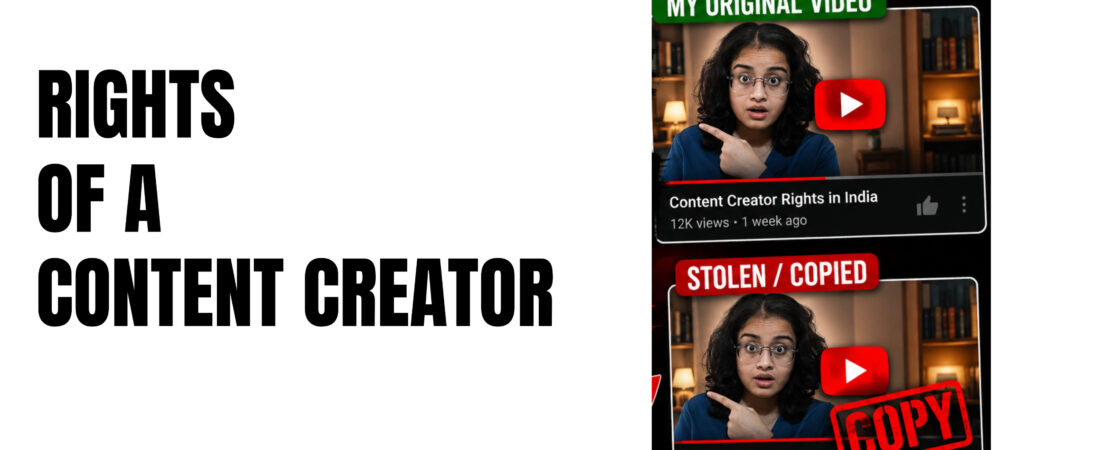
Imagine spending days researching, scripting, recording, and editing a video — only to find it copied and re-uploaded by someone else within the week. You report it to the platform. Nothing happens. You feel powerless.
This scenario plays out for Indian content creators every single day. And the reason most of them cannot fight back is simple: they do not know what the law says.
India has a legal framework that can protect content creators — but it is scattered, inconsistently enforced, and contains critical gaps that leave creators vulnerable. This article examines your rights as a content creator in India: what protects you, what does not, and what you need to do right now.
1. Freedom of Expression — Your Constitutional Foundation
https://indiankanoon.org/doc/1218090/
Before we get to specific laws, it is important to understand the constitutional bedrock on which all creator rights rest.
Article 19(1)(a) of the Constitution of India guarantees every citizen the fundamental right to freedom of speech and expression. This right is not limited to written speech or political discourse — it extends to all forms of creative, educational, and journalistic expression, including:
YouTube videos and short-form reels
Podcasts and audio content
Blog articles and newsletters
Digital art and graphic design
Online journalism and investigative content
This constitutional right means that the State cannot arbitrarily silence a content creator. It forms the foundation of the right to publish and broadcast your work in the digital space.
Important caveat: Article 19 protects you against STATE interference. It does not automatically protect your content from being stolen, plagiarised, or misused by other private individuals or platforms. For that, we turn to intellectual property law.
2. Copyright — The Most Powerful Tool in a Creator’s Arsenal
https://share.google/Ddc3zOMiKcsVwsFTK
The single most important law for content creators in India is the Copyright Act, 1957. Despite its age, this law has been amended multiple times and fully applies to digital content created and published online.
2.1 Copyright Arises Automatically
Here is something most creators do not know: you do not need to register your work to own copyright. The moment you create an original piece of work — a video, an article, a script, a photograph, a podcast episode — copyright protection is automatically yours.
There is no form to fill, no fee to pay, no government office to visit. Your creative output is legally protected from the moment of creation.
2.2 What Exactly Is Protected?
Under the Copyright Act, the following types of content are protected:
- Video scripts and the final recorded video
- Blog posts, articles, and long-form written content
- Original thumbnails, infographics, and graphic designs
- Music compositions, voiceovers, and jingles
- Podcasts and audio recordings
- Original photographs used in content
- Course materials and e-books
2.3 How Long Does Protection Last?
Copyright protection in India lasts for the entirety of the creator’s lifetime plus 60 years after their death. This means the work of a creator who dies today will remain legally protected until 2086. For content creators building a library of work, this is significant long-term protection.
2.4 Economic Rights vs. Moral Rights
The Copyright Act grants creators two distinct categories of rights:
Economic Rights: The right to earn from your work. This includes the right to reproduce it, distribute it, perform it publicly, broadcast it, and license it. If a brand wants to use your video in an advertisement, they need your permission — and you can charge for it. Economic rights can be transferred or licensed to others.
Moral Rights (Section 57): These are personal rights that exist independently of economic rights. The Copyright Act provides creators with two permanent moral rights:
Right of Paternity — The creator must always be acknowledged as the true author of the work. No one can falsely claim credit for content you have created.
Right of Integrity — The creator can legally oppose any distortion, mutilation, or modification of their work that would be prejudicial to their honour or reputation.
Crucially, moral rights under Section 57 are permanent and non-transferable. Even if you sell or license your economic rights to a media company, brand, or platform — your moral rights remain with you. You cannot sign them away.
3. The Fair Dealing Problem — A Critical Gap in Indian Law
If copyright is the shield, then ‘fair dealing’ is the double-edged sword — and in India, it cuts against creators more than it helps them.
Section 52 of the Copyright Act lists situations where using someone else’s copyrighted work is permitted without their permission and without payment. These ‘fair dealing’ exceptions include:
- Private study or research
- Criticism or review of a work
- Reporting of current events
- Educational use in classrooms
The critical problem: India’s fair dealing exceptions are extremely narrow. Unlike the United States, which has a broad ‘fair use’ doctrine that protects transformative works — including commentary, parody, remixing, and reaction content — India’s Section 52 does not adequately shield such creative reuse.
This has real consequences for creators. A YouTuber who makes a commentary video referencing another creator’s work, a podcaster who discusses a news clip, or a blogger who analyses a viral video — all of these creators may technically face copyright claims even when their use is genuinely creative and public-interest-oriented.
Legal scholars and digital rights advocates have called for India to adopt a more flexible fair use standard — one that evaluates the purpose, nature, amount, and market effect of the use, as courts do in the United States. Until that reform happens, this remains one of the most significant gaps in Indian creator protection law.
4. Platforms, the IT Act, and What Safe Harbour Means for You
The relationship between content creators and digital platforms — YouTube, Instagram, Spotify, streaming services — is governed in part by India’s Information Technology Act, 2000 and its amendments.
4.1 The Safe Harbour Principle
The IT Act gives digital platforms ‘safe harbour’ protection — they are not directly liable for content posted by their users, as long as they act upon valid takedown notices in a timely manner.
For content creators, this cuts both ways. On one hand, it means platforms will not face liability for your content — protecting open publication. On the other hand, it means when someone steals and re-uploads your work, the platform’s obligation is limited to acting on your complaint. It does not proactively protect you.
4.2 The IT Rules, 2021 and Grievance Mechanisms
The Information Technology (Intermediary Guidelines and Digital Media Ethics Code) Rules, 2021 require significant social media platforms to appoint grievance officers and resolve complaints within specified timelines. If your content has been wrongfully removed — or if your stolen content has not been taken down — these grievance mechanisms are your first formal escalation path before approaching a court.
5. The DPDP Act, 2023 — New Obligations for Creators
India’s Digital Personal Data Protection Act, 2023 — and the Rules notified under it in November 2025 — introduces a new layer of compliance that many content creators are not yet aware of.
If you create content that involves any of the following, you may be classified as a ‘Data Fiduciary’ under the DPDP Act:
- Featuring real, identifiable individuals in your videos or articles
- Running a subscriber list, newsletter, or online community
- Collecting viewer data through forms, surveys, or analytics tools
- Conducting interviews and publishing personal information about your subjects
As a Data Fiduciary, you have legal obligations around how you collect, use, store, and delete personal data. You must obtain meaningful consent, provide notice of data use, and have a mechanism for individuals to access or delete their data.
The full citizen-facing rights under the DPDP Act — including the right to correction, erasure, and grievance redressal — will not come into full effect until mid-2027. But obligations for those processing data start earlier. Creators should begin building consent practices now.
6. Advertising, Disclosure, and ASCI — Responsibilities Alongside Rights
A complete understanding of creator rights must also include creator obligations — particularly around commercial content. The Advertising Standards Council of India (ASCI) has issued Influencer Advertising Guidelines that apply to all content creators engaged in paid promotion.
Key disclosure requirements:
- All paid promotions must be clearly labelled — using terms like #ad, #sponsored, #collab, or #partnership — in a visible, prominent manner
- Labels must appear before the ‘see more’ fold on Instagram, YouTube descriptions, and other platforms
- These requirements apply to all content formats: videos, static posts, Stories, podcasts, and blog articles
- Virtual influencers and AI-generated personas are also subject to these rules
Beyond ASCI guidelines, the Consumer Protection Act, 2019 — and its e-commerce rules — impose legal liability on endorsers who make false or misleading claims about products. A content creator who promotes a product they have not used, or makes health claims without basis, could face regulatory action.
The Ministry of Information & Broadcasting’s 2023 notification strengthened enforcement of these rules. Non-disclosure is no longer just an ethical lapse — it can carry legal consequences.
7. Artificial Intelligence — The Biggest Unaddressed Threat
Perhaps the most significant challenge facing content creators in India today is one that existing law is almost entirely unprepared for: artificial intelligence.
AI systems are being trained on vast datasets that include content created by people like you — your videos, your scripts, your voice, your writing style. Your content may have been scraped and used to train an AI model without your knowledge or consent. That model can then produce content that directly competes with yours.
What Indian law currently says about AI and copyright:
- The Copyright Act, 1957 does not recognise AI as a legal author — only human beings can hold copyright. This is correct in principle.
However, the Act does not clearly address what happens when a human creator’s copyrighted work is used as training data for an AI system. - There is no opt-out mechanism — unlike under the EU’s AI Act, Indian creators cannot formally request that their work be excluded from AI training datasets.
- There is no compensation framework for creators whose work is used to train commercial AI products.
- Ownership of AI-assisted output — where a human uses AI as a tool in the creative process — remains legally ambiguous.
India is watching global developments — the EU AI Act, US copyright litigation involving AI training, and the UK’s data mining exceptions — but has not yet enacted specific creator protections in this space. This will likely become the defining legal frontier for the Indian creator economy in the next five years.
8. Five Steps Every Content Creator Should Take Right Now
Understanding your rights is only half the battle. Here is what you should practically do to protect your work:
Step 1: Document Your Creation Process
Keep dated records of everything — your research notes, script drafts, edit versions, and upload history. In any copyright dispute, establishing when you created something is critical. Cloud platforms like Google Docs preserve version history automatically. Use this as evidence of your prior creation.
Step 2: Add Copyright Notices to All Your Content
In your video descriptions, website footers, and articles, include: © 2026 [Your Name / Channel Name]. All Rights Reserved. While this does not grant you additional rights, it signals intent and strengthens your position in any infringement claim.
Step 3: Use YouTube’s Copyright Takedown Tools
If your video is stolen and re-uploaded on YouTube, you can file a copyright takedown notice through YouTube’s Copyright Complaint process. This is effective and legally recognised. YouTube will remove the infringing content after verification. Indian courts have also upheld DMCA-equivalent takedown processes.
Step 4: Consider Formal Copyright Registration for Major Works
Though copyright arises automatically, you can register it with the Copyright Office of India (copyright.gov.in). Registered copyright is significantly easier to enforce in court — it creates a formal legal record of your ownership. For major works like documentary films, full-length courses, published books, or original music, registration is strongly advisable.
Step 5: Read Every Brand Contract Carefully
When brands, agencies, or media companies approach you with collaboration agreements, read the intellectual property clause carefully. Ensure the contract does not include unlimited, perpetual rights to your content, voice, or likeness. Remember: your moral rights cannot be signed away — but economic rights can be, and many standard contracts are drafted to extract maximum rights from creators at minimum cost.
Content creators are the journalists, educators, storytellers, and voices of the digital age. They deserve to understand what the law says about protecting their work.
The Copyright Act gives you a powerful foundation — automatic protection, strong moral rights, and the right to earn from your creative output. But the gaps are real. India’s narrow fair dealing framework, the absence of AI-specific creator protections, and the lack of a dedicated creator-employment law mean that the legal infrastructure is still catching up with the realities of the creator economy.
The best thing you can do as a creator is stay informed. Know what protects you. Know what doesn’t. And advocate for the reforms that will bring Indian law in line with a digital world.
Write Feedback
Youtube Video
Read More….
- Can a Doctor Lose Their License for What They Say at a Comedy Show?
- Rights of Content Creators in India: What the Law Protects — and What It Doesn’t
- DIGITAL PERSONAL DATA PROTECTION ACT, 2023

- RIGHT TO PRIVACY IN INDIA
- Stop Eating Newspaper-Wrapped Food: FSSAI Issues Fresh Warning After Mumbai Vada Pav Incident