By Konika Gayen | May 2026 | 7 minutes read
In the third week of May 2026, three women died in three different
Indian cities. One week. Three deaths. Three variations of the same
story told millions of times in this country over six decades.
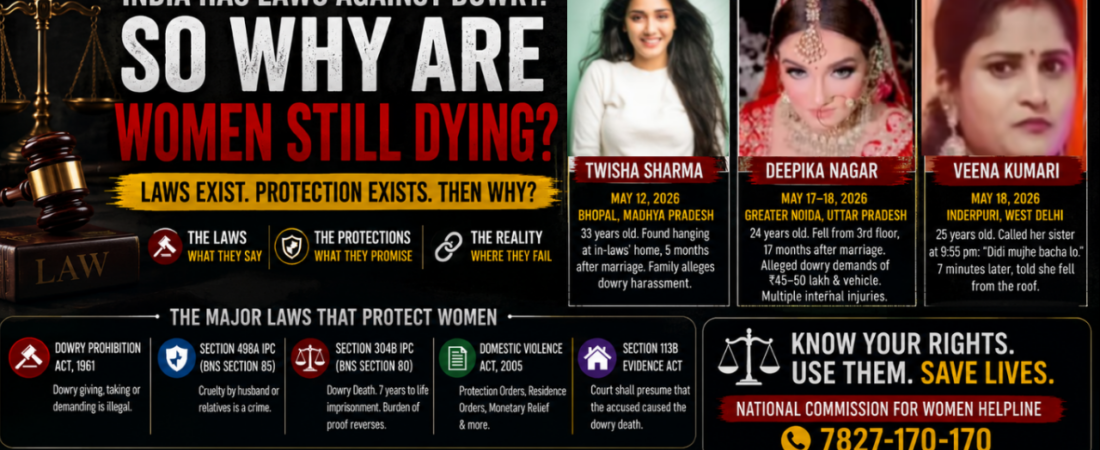
Twisha Sharma, 33, was found hanging at her in-laws’ home in Bhopal
on May 12 — five months after her wedding. Her husband is a lawyer.
Her mother-in-law is a retired district judge.
Deepika Nagar, 24, died on the night of May 17-18 after falling from
the third floor of her in-laws’ house in Greater Noida — 17 months
after a wedding her family estimates cost close to Rs 1 crore,
including a Fortuner car. Her in-laws allegedly demanded Rs 45-50 lakh
in cash and another vehicle. Hours before she died, her father had
visited the house after she called saying she was being assaulted. The
post-mortem found brain haemorrhage, a ruptured spleen, a ruptured
kidney, bleeding from the nose and mouth. Some injuries, doctors noted,
appeared to have been caused before she fell.
Veena Kumari, 25, died in Delhi’s Inderpuri on the night of May 18.
At 9:55 pm, she called her sister. “Didi mujhe bacha lo. Ye mujhe
bahut maar rahe hain. Main bachungi nahi.” Save me, sister. They are
beating me terribly. I will not survive. She asked her sister to take
care of her six-month-old son. At 10:02 pm — seven minutes later —
the sister received a second call, from the brother-in-law. Bhabhi
chhat se gir gayi. She had fallen from the roof.
Three women. One week. Bhopal, Greater Noida, Delhi.
According to the National Crime Records Bureau’s Crime in India 2024
report, India recorded 5,737 dowry deaths that year — nearly 16 women
every single day. One every 90 minutes. Between 2023 and 2024, dowry-
related suicides rose by 6.7 percent. Uttar Pradesh alone accounted
for more than a third of national cases. Delhi has been the metro city
with the highest number of dowry deaths for five consecutive years.
India banned dowry in 1961. That is 65 years ago.
This article is not about outrage. It is about the law — what it
says, what it promises, and where the gap between the two lives.
Scroll Down for reading the complete article
THE LAWS THAT EXIST
1. THE DOWRY PROHIBITION ACT, 1961
The first thing to understand is that dowry has been illegal in India
for longer than most citizens have been alive.
The Dowry Prohibition Act of 1961 makes it a criminal offence to give
dowry, to take dowry, or to demand it. The penalty is up to five years
in prison and a fine of Rs 15,000 or the value of the dowry — whichever
is higher.
This means that every transaction at every Indian wedding — the cash
envelope, the car in the courtyard, the jewellery delivered in advance
— is, strictly speaking, a violation of a law passed by Parliament
in the first decade after Independence.
The Dowry Prohibition Act has never been the primary tool of
prosecution in dowry harassment cases, for a structural reason: both
the giver and the taker are technically guilty. This creates a mutual
incentive for silence. The law targets the transaction. It cannot, by
itself, address what happens inside a marriage after the transaction
has already occurred.
That is why Parliament, over the decades that followed, built
additional protections directly into the criminal code.
2. SECTION 498A — CRUELTY BY HUSBAND OR HIS RELATIVES
(Now Section 85, Bharatiya Nyaya Sanhita)
Section 498A was inserted into the Indian Penal Code in 1983. Its
addition was a direct response to the bride-burning cases of the late
1970s and early 1980s — deaths that had sparked India’s first mass
anti-dowry protests on the streets of Delhi. Parliament recognised
that the Dowry Prohibition Act could not address ongoing cruelty
inside a marriage. A new provision was needed, one that criminalised
the behaviour itself, not just the transaction at its start.
Section 498A — now mirrored as Section 85 under the Bharatiya Nyaya
Sanhita — makes it a criminal offence for a husband or any of his
relatives to subject a woman to:
(a) Wilful conduct likely to drive her to suicide, or to cause
grave injury to her life, health, or safety — physical or
mental; or
(b) Harassment to coerce her or her family into meeting unlawful
demands for property or money.
The penalty: up to three years imprisonment and a fine.
Two features make this provision particularly significant in practice.
First, it is a cognisable offence. This means the police can arrest
without first obtaining a warrant from a magistrate. A complaint
alone is sufficient for an FIR to be registered and action to follow.
Second, it is non-bailable. Bail for the accused is not automatic.
They must apply to a court, and the court can deny it.
FIRs under Section 498A have been registered in the Twisha Sharma,
Deepika Nagar, and Veena Kumari cases.
It is important to note that Section 498A has also been the subject
of sustained legal debate. The Supreme Court has, in multiple
judgments, raised concerns about its misuse in matrimonial disputes
where no genuine harassment occurred, and has issued guidelines to
prevent automatic arrests without preliminary investigation. Those
guidelines exist to protect against false cases — they do not diminish
the law’s core purpose, which is to provide immediate criminal
recourse to women facing genuine dowry-related cruelty.
3. SECTION 304B — DOWRY DEATH
(Now Section 80, Bharatiya Nyaya Sanhita)
This is the most powerful legal provision in India’s dowry framework
— and the least understood.
Section 304B defines a Dowry Death. Three conditions must be met:
(a) The woman dies within seven years of marriage.
(b) Her death is caused by burns, bodily injury, or occurs under
circumstances that are not normal.
(c) She was subjected to cruelty or harassment — in connection
with demands for dowry — soon before her death.
If all three conditions are satisfied, the death is classified as a
Dowry Death in law.
The penalty: a minimum of seven years imprisonment. A maximum of
life imprisonment.
But the most significant feature of Section 304B is not the sentence.
It is what happens to the burden of proof.
In ordinary Indian criminal law, the prosecution must prove guilt
beyond reasonable doubt. The accused is presumed innocent. Section
304B reverses this. Once the prosecution establishes the basic facts
— unnatural death, within seven years, preceded by dowry-linked
cruelty — the presumption shifts. The accused must prove they did
not cause the death through dowry-related harassment. The law assumes
guilt. They must disprove it.
This reversal exists because Parliament understood a fundamental
reality about domestic deaths: the evidence is almost always inside
the home. The scene is controlled by the accused. The witnesses are
the accused’s own family members. The woman who could have spoken
is dead. Without a reversed presumption, convictions in such cases
would be extremely rare.
Section 113B of the Indian Evidence Act reinforces this: in a trial
involving a dowry death, the court shall presume the accused caused
the death once the prosecution establishes the foundational facts.
“Shall presume” — not “may presume.” It is a legal instruction, not
a discretion.
Consider the Deepika Nagar case through this lens. She was 24.
She died 17 months into her marriage — well within the seven-year
window. Her post-mortem documented brain haemorrhage, ruptured
organs, and injuries doctors noted may have preceded her fall. Her
family had complained of sustained dowry demands. All three conditions
of Section 304B are potentially satisfied. Under the law, it is
then for the accused to show otherwise.
4. THE PROTECTION OF WOMEN FROM DOMESTIC VIOLENCE ACT, 2005
Criminal law is reactive. It engages after harm has occurred. The
Domestic Violence Act of 2005 is designed to be preventive — to
provide civil protection before a situation becomes irreversible.
The DV Act covers physical, emotional, verbal, economic, and sexual
abuse. It does not require the abuse to be connected to dowry. It
applies to any woman in a domestic relationship — married, formerly
married, or in a live-in arrangement. It also covers women living
in the same household as the abuser, including daughters-in-law
living with in-laws.
Under the DV Act, a woman can approach a Protection Officer — one
exists in every district in India — or apply directly to a Magistrate
for any of the following:
Protection Order: A court direction legally prohibiting the abuser
from contacting, approaching, or harming the woman.
Residence Order: A direction ensuring the woman cannot be thrown
out of the shared household, or requiring the abuser to provide
alternative accommodation.
Monetary Relief: Compensation for medical expenses, loss of
earnings, and maintenance for the woman and her children.
Custody Order: Interim custody of her children.
The crucial distinction from Section 498A is that the DV Act is civil
rather than criminal. The woman does not have to want her husband
arrested. She can obtain legal protection without initiating a
criminal prosecution. This matters because many women in abusive
marriages face additional pressure — from both families — not to
“go to the police.” The DV Act provides a route that does not require
a criminal case to be filed, and that can deliver relief within days.
Veena Kumari was married in 2022. The family alleges three years of
harassment — over complexion, over the size of a television set,
over gifts that were compared unfavourably to those given at another
family wedding. Three years in which the DV Act was accessible. A
Protection Officer was available. A Magistrate could have issued
relief. The law was there. It was not reached.
5. THE ESCALATION PATH: WHAT YOU CAN DO
The existence of laws means nothing if people do not know how to
access them. Below is the escalation path available under Indian law,
in order of urgency.
STEP 1 — FILE AN FIR UNDER SECTION 498A
Go to the nearest police station. Section 498A is cognisable: the
police are legally required to register the FIR. If they refuse, you
can approach the Superintendent of Police in writing, or file a
complaint directly before a Magistrate under Section 156(3) CrPC,
which directs the police to investigate.
STEP 2 — APPROACH A PROTECTION OFFICER UNDER THE DV ACT
Every district in India has a designated Protection Officer. They
can assist with filing for a Protection Order the same day. No lawyer
is required at this stage.
STEP 3 — CONTACT THE NATIONAL COMMISSION FOR WOMEN
The NCW takes cognisance of dowry harassment cases and can direct
state police to investigate. They have a dedicated helpline:
7827-170-170.
STEP 4 — PETITION THE HIGH COURT
If the local police investigation appears compromised or inadequate,
the High Court can be petitioned. It can order a CBI transfer, as
happened in the Twisha Sharma case following the MP government’s own
recommendation. It can order a second post-mortem — which the family
in the Twisha Sharma case secured, with the examination conducted at
AIIMS Delhi. It can issue writs directing police to take specific
investigative steps.
STEP 5 — THE SUPREME COURT
In extreme cases — particularly where the failure of local
institutions is systemic or where the accused’s position raises
questions about institutional impartiality — the Supreme Court can
take suo motu cognizance. It did so in the Twisha Sharma case on
May 25, 2026. The Chief Justice’s bench noted it was “deeply pained”
by the allegations. The Solicitor General submitted that the accused
had been appearing on television channels making statements about the
victim. The CBI took over the investigation the same day.
————————————————————
THE GAP BETWEEN LAW AND REALITY
————————————————————
The laws are not weak. Section 304B’s reversed burden of proof is
one of the most victim-protective provisions in Indian criminal law.
The Domestic Violence Act is comprehensive. Section 498A is immediate
and cognisable. The Dowry Prohibition Act is 65 years old.
And yet, the NCRB’s 2024 data shows that acquittals in dowry death
trials still outpace convictions, though the gap has narrowed. Of
cases that reached verdict in 2024, convictions stood at 46.2 percent
against acquittals at 50.1 percent. Legal experts consistently point
to the same causes: delayed investigations, witnesses who turn hostile
under family or social pressure, loss of forensic evidence, and the
difficulty of proving intent in deaths that occur inside private homes.
In the Twisha Sharma case, there were reports of a delay of several
days in FIR registration. In the Deepika Nagar case, the family and
the police initially offered conflicting accounts of whether the death
was a murder or a suicide under duress. In the Veena Kumari case, the
husband claimed she fell; the family said she was thrown.
This is the structure of almost every dowry death case in India.
The scene is private. The witnesses are the accused. The victim
cannot speak.
The law accounts for this — that is precisely why Section 304B
reverses the burden of proof. But the law can only function when the
investigation that precedes a trial is competent, timely, and free
from institutional pressure.
In the Twisha Sharma case, the question of whether a retired judge’s
connections could create friction in a local investigation was serious
enough that the Supreme Court of India stepped in on its own. That
step — extraordinary in any context — is itself a form of evidence
about the gap that can exist between what the law says and what
actually happens in practice.
The Solicitor General, arguing before the Supreme Court on May 25,
2026, said: “It is better to have a divorced daughter than a dead one.”
That sentence, delivered inside the Supreme Court, is not a legal
argument. It is an acknowledgment of a social reality that law alone
cannot correct. The laws exist. The architecture is in place. The
failure — when it occurs — is in enforcement, institutional
accountability, and the social conditions that make women reluctant
to invoke their rights until it is too late.
—————————————-
Three women. One week. Bhopal. Greater Noida. Delhi.
Twisha Sharma. Deepika Nagar. Veena Kumari.
Their deaths are not exceptional. India loses nearly 16 women to
dowry-related deaths every single day. What made this particular week
visible was the volume of coverage and the specific detail of the
Twisha Sharma case — the husband who is a lawyer, the mother-in-law
who is a retired judge, and a Supreme Court that stepped in before
anyone had to ask.
The laws that could have protected these women existed before their
weddings. The laws that will now be used to prosecute those
responsible exist today.
The question this country has not answered in 65 years of legislation
is not a legal one. It is a question about implementation, about
institutional courage, and about whether a woman in distress — in
Bhopal, in Greater Noida, in West Delhi — can actually reach the
protections that the law has, on paper, given her.
Knowing your rights is not a solution to a broken system.
But it is a place to start.
————————————————————
KEY RESOURCES
————————————————————
National Commission for Women Helpline: 7827-170-170
National Women Helpline (One Stop Centre): 181
Police Emergency: 100
Legal Aid (National Legal Services Authority): 15100
————————————————————
A NOTE ON THE TWISHA SHARMA INVESTIGATION
————————————————————
The Supreme Court of India has requested that media avoid publishing
statements from either side — the victim’s family or the accused —
while the CBI investigation is ongoing. This article relies on
publicly documented facts, court proceedings, post-mortem records
reported in the press, and verified NCRB data. It does not reproduce
statements made by either family or the accused to television channels
or reporters. We will update our coverage as the investigation
develops.
————————————————————

- LEAK PROTECTION: Provides Long Lasting Protection
- LEAK PROTECTION: Upto 100% Stain Protection All Day
- DRY: Keeps you clean and dry
————————————————————